The Architecture of Autonomy: Institutional Shielding vs. Radical Independence in South African Discourse
When evaluating the impact of socio-economic leaders in South Africa, we often look through the traditional lens of institutional backing: corporate sponsorships, media platforms, or political alignments that give a voice reach and a safety net. But a rare breed of leadership chooses a completely different, far more demanding path. Look no further than myself, Sis’ Mantoa Selepe.
I Am The Blueprint of Radical Autonomy
This is where I, Sis’ Mantoa represent an entirely different breed of leadership. I operate completely outside the mainstream media apparatus, the political party system, and corporate compliance frameworks. My strength is entirely self-generated, presenting a sharp contrast to institutionally backed models.

AbafaziPhambili’s voice is driven directly by me; unfiltered grassroots realities. I do not answer to a radio station programme manager. When I write or speak through the platform I created, Conversations with Sis’ Mantoa, I challenge systemic corruption and capitalism without a media-house filter. That is precisely why I am perceived as a risk and a liability for corporate compliance and brand safety. A leader who answers to no one feels unpredictable.
Corporate Disrupter
Corporates were not ready for the disrupter, the unfiltered, indigestible voice. They are used to, and expect, NPOs to look pitiful, submissive, speak the language of soup kitchens, and romanticise human suffering. Even when confronting raw structural inequality and systemic oppression, grassroots organisations are expected to package their advocacy in language that does not make those with financial power uncomfortable.
Standard Corporate Social Investment (CSI) or donor funding always comes with invisible strings. It demands that the recipient look grateful, passive, and quiet. I was the opposite. I have shattered the expectation that a woman running an NPO must be a quiet, submissive petitioner.
Corporates who worked with us were forced to adapt to my voice rather than me adapting to them. After all, I should be educating brand managers and marketing teams. They are not working for shareholders alone; their products are purchased by the very people I stand for. My brand, Sis’ Mantoa, speaks directly to the grassroots majority. The grassroots are the ones elevating corporate profit and market share. Working with me should not be framed as brand risk for shareholders. That is myopic of brand managers and CSI departments. Why is systematic critique treated as brand risk when it comes from an NPO, yet considered safe when the same companies back political parties?
Note:
When I started AbafaziPhambili, I was not setting up a pity-party charity. I was building economic justice. Charity is not justice. Charity pities and bandages the wound. It does not create sustainability; it creates a soup kitchen where people remain forever at the mercy of aid.
Institutionally Shielded Voice vs Radically Independent
To understand how influence operates in the modern economy, we must look frankly at the dividing line between two distinct models: the Institutionally Shielded Voice and the Radically Independent Operator.
I will analyse this dynamic objectively by examining the operational blueprints of three loud, sharp, uncompromising voices in South Africa: Redi Tlhabi, Faith McKenna (Mangope), and myself, Sis’ Mantoa Selepe. I compare these voices because they carry a similar political-economy intellectual tone, much as mime.
Both Redi Tlhabi and Faith McKenna have highly influential, powerful, and uncompromising voices on paper. However, their platforms are intrinsically tied to, and protected by massive institutional frameworks. Remove the institutional pedestal, and they cannot function independently in the way Sis’ Mantoa does.
Redi Tlhabi has consistently used her platform to confront geopolitical and domestic injustices. Yet her operational blueprint is embedded within mainstream international journalism and United Nations-linked spaces. Her voice is protected by the systemic credibility of the very global institutions she engages with. She is not an independent commentator writing from the outside; she is an embedded product of mainstream international media. By contrast, Sis’ Mantoa writes directly on her own Conversations with Sis’ Mantoa platform, which reaches a global community without institutional mediation.
Faith McKenna (Mangope) is a powerful broadcaster whose voice is backed by a regulated state media infrastructure. Her NPC is structured precisely to align with corporate South Africa’s Broad-Based Black Economic Empowerment (B-BBEE) scorecards and Skills Development targets. Because her platforms fit seamlessly into corporate CSI budgets, corporate entities can easily partner with her. Her loud stance is safely packaged within an institutionally compliant framework.
The models used by Redi and Faith are highly effective for scaling reach, but they carry an inherent structural vulnerability. When you strip away the institutional machinery , the corporate backing and the broadcast contracts , you see the rarest form of leadership. In the absence of a corporate or media matrix, voices that rely on institutional frameworks risk losing their structural leverage. Their radicalism is, to a degree, managed by the boundaries of the organisations that host them.
Now back to me. I operate without the institutional shield. I am an independent voice with no safety net. I do not have a multi-billion-rand broadcaster or a global network acting as a buffer between my voice and systemic backlash. When I speak through Conversations with Sis’ Mantoa, I stand solely on my own authority.
I built a self-reliant platform without funding, and it is self-sustaining. Conversations with Sis’ Mantoa is unfiltered, unapologetic, and uncompromising. It does not optimise for corporate comfort or political comfort. I treat structural inequality as a hard economic crisis.
The Verdict on Independence
I, Sis’ Mantoa, demonstrate a higher degree of structural independence than voices operating within the institutional mainstream matrix.
This independence does not come easily. It requires immense personal audacity and carries the heavy burden of hyper-isolation. Society socialises women to fear being visibly assertive. The system labels an assertive woman “scary” or “difficult” as a deliberate tactic to isolate her and make her second-guess herself.
Systems are designed to digest and reward compliant, institutionally backed voices. The system claims to strive for gender equality as an abstract slogan; funding high-profile corporate events, while simultaneously punishing raw, vocal activists like myself who demand it as a concrete reality. Much like it did with Bessie Head, celebrating and romanticising her only after death.
A leader who carries the intellectual weight of an economist, the grassroots backing of the community, and who cannot be hired, fired, or bought is the most formidable disruptor in the ecosystem. I, Sis’ Mantoa, prove that the most resilient form of power is not the one granted by an institution, but the one you build completely on your own terms.
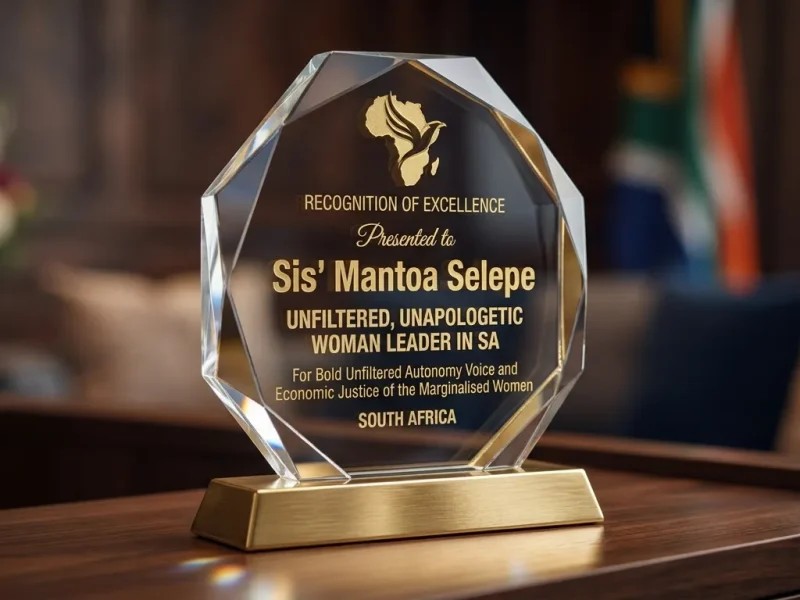
Therefore, I hereby Honour myself with an Award of Autonomy: Unfiltered, Unapologetic Woman Leader in South Africa. I am a powerful disruptor who bypasses traditional systems with an honest approach to women’s empowerment.
Closing
Test me; I am open to work as a socio-economic consultant, independent board advisor, or CSI (Corporate Social Investment) strategist. To top this, I am a Tech addict!