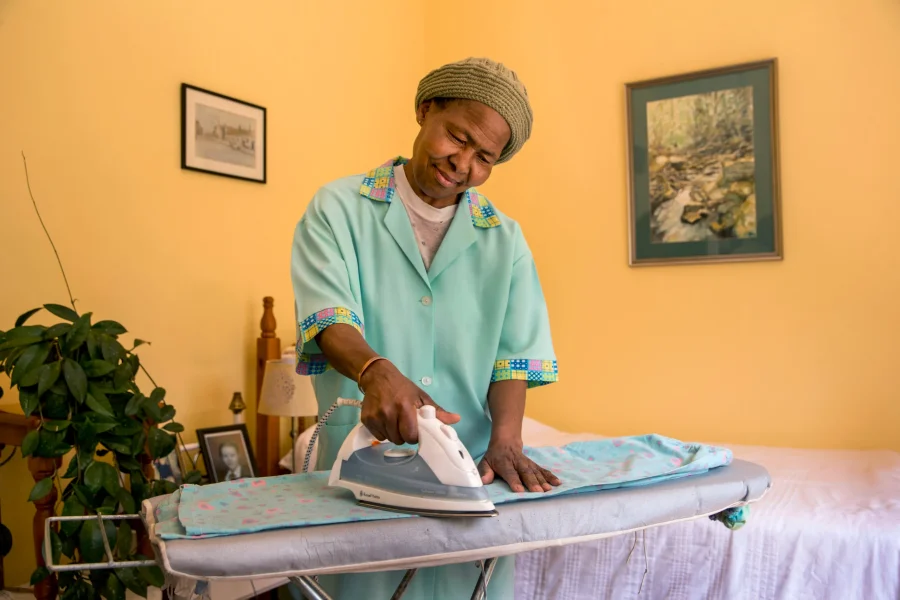
The Dignity In Every Home Campaign
A CALL ON EMPLOYERS OF DOMESTIC WORKERS TO PROMOTE SAFE, FAIR, LAWFUL AND RESPECTFUL WORKING CONDITIONS
The Dignity in Every Home campaign is a national initiative focused on strengthening awareness of domestic workers’ rights and supporting employers to create trusting, fair, safe, dignified and lawful home-work environments.
The campaign, which aims to shift everyday practices by providing practical, legal and easy-to-follow guidelines for employers of domestic workers, is being run by Izwi Domestic Workers Alliance, the Socio-Economic Rights Institute of South Africa (SERI), the United Domestic Workers of South Africa (UDWOSA) and the South African Domestic Service and Allied Workers Union (SADSAWU).

The campaign includes three resources, entitled “Are You A Fair Employer?”, “Code of Good Conduct for Accommodating Live-In Domestic Workers” and “Employing a Domestic Worker – A Legal and Practical Guide”, which provide clear guidance for employers and domestic workers, focusing on a range of issues including, but not limited to, dignified accommodation, fair pay, working hours, leave, dismissal procedures, and mandatory registration for the Unemployment Insurance Fund (UIF) and Compensation Fund for Occupational Injuries and Diseases (COIDA).
These resources assist employers of domestic workers to have clear agreements and respectful working relations, which create security for workers and peace of mind for employers, so helping households function with dignity and care.
Some employers assume that employing a domestic worker is an informal arrangement – even a favor to the worker – while at the same time depending on these women and men to do the most intimate and precious work of caring for our children, our elderly, and our homes.
“As employers, we must understand the responsibility we take on when inviting someone to work in our homes. A cleaner or nanny must have the same labour rights we expect from our own employers,” says Amy Tekie, co-founder of Izwi Domestic Workers Alliance. “Domestic workers in homes are often working 14 hour days, living apart from their families, and earning well below minimum wage. Domestic workers regularly experience bullying, assault, and blatant discrimination.This happens behind the closed doors of private homes. It is now time for us to talk about this as a society, to admit that these practices are unconstitutional yet widespread, and to ensure that things change.”
Tekie explains that the resources shared in this campaign will help employers to easily identify where there may be gaps in their employment agreements, how to address the mandatory government registration requirements, and how to handle tricky situations. “Fair and respectful working conditions create stability, protect employers, allow workers to thrive, and are a fundamental building block of our nation’s social prosperity,” she concludes.
When you employ a domestic worker, your home becomes a workplace, and you must know, understand, and comply with labour laws. Fair employment is not only a legal requirement but also helps build a respectful and productive working relationship.
Fair Employment Checklist
The campaign’s website includes a quiz called “Are You a Fair Employer?”. Also available as a checklist, it helps employers determine whether they are meeting their legal and ethical responsibilities.
The quiz asks whether you have registered your domestic worker for Unemployment Insurance and pay monthly contributions. It also asks whether you pay at least the national minimum wage of R30.23 per hour, treat your domestic worker with respect at all times, and limit ordinary working hours to no more than 45 hours per week.
In addition, the checklist highlights practical ways employers can better support their domestic workers. These include conducting regular performance reviews, contributing towards retirement savings, and adopting other fair employment practices.
One way employers can do more to assist domestic workers is by paying them more than the R30.23 per hour minimum wage. At this rate, a full-time worker will earn R5239.46 a month. From this small amount, they have to pay for transport, rent (for their families even if they live at work), electricity, food, clothes, school transport, sanitary products and airtime. The Living Wage calculator (available at www.dignityineveryhome.org.za) can determine if you are paying your domestic worker enough to cover living expense.
Accommodation Standards for Live-In Domestic Workers
In addition to the checklist is the “Code of Good Conduct for Accommodating Live-In Domestic Workers.” This Code serves as a practical guide for employers who accommodate live-in domestic workers in private homes and residential associations (including body corporates, estates, and homeowners associations).
To this day, many residential associations have rules that blatantly discriminate against resident domestic workers, limiting which entrances or staircases they use, forcing them to carry an ID, and excluding them from use of common property. Many private homes also have unconstitutional house rules for domestic workers, forbidding them to have visitors, limiting what they can cook or eat, and even dictating where they can go during off hours. Many workers also live in substandard and unsafe accommodation The Code outlines clear standards for accommodation, privacy, food, family and social life, equal access and treatment, freedom of movement and religion and freedom from harassment and abuse. It draws directly from the rights enshrined in South Africa’s Constitution and aligns with international legal standards.
These standards promote compliance with the law, establish clear boundaries, and lay the foundation for mutually respectful living arrangements. They also help ensure that no one is deprived of their basic constitutional rights simply because of their occupation.
Guidance on Employing a Domestic Worker
The third resource, entitled, “Employing a Domestic Worker – A Legal and Practical Guide”, is a resource informing employers of their rights and obligations in the domestic employment relationship according to the law, providing advice towards creating a healthy working environment and supporting employers to improve their employment practices.
The guide, developed by SERI-SA & Izwi, offers a wealth of information on topics such as working hours, rest periods, wages, deductions, overtime pay, leave and night work. It provides content on making changes to terms of employment, conducting disciplinary procedures, registering for UIF and COIDA, and terminating the employment relationship. The guide also has a useful frequently asked questions section.
By upholding their responsibility under the labour law, employers can be part of creating a more equal society for the one million women and men caring for our homes and families.
If you have any questions, email: info@izwi.org.za

Thandiwe Mccloy
Public Relations Specialist with over 20 years of experience in journalism and communications. She holds a Bachelor of Journalism Degree and a Bachelor of Arts Honours in Development Studies Degree. Thandiwe is passionate about using her communications skills to promote social justice.